
Kerala Chief Minister Pinarayi Vijayan held an online meeting with Loka Kerala Sabha members in the Gulf region to discuss support for the expatriate community amidst the escalating conflict in West Asia.

Nepal is actively involved in rescuing its citizens from Gulf countries due to escalating tensions in West Asia, with thousands registering to return home. The government is committed to ensuring the safety of Nepalese citizens in the region and has formed an Emergency Response Team to manage the crisis.

Mohanlal's highly anticipated film Drishyam 3 has been postponed from its initial April 2 release to May 21, coinciding with the actor's birthday, due to ongoing war tensions in the Gulf region and the upcoming Kerala elections.

Donald Trump has escalated rhetoric against Iran by posting AI-generated images and videos depicting US military strikes, warning Tehran that time is running out to secure a ceasefire agreement.

Former US President Donald Trump has issued a stern warning to Iran, stating that "nothing will get through" unless a deal or "total surrender" is achieved, amid escalating tensions and conflicting reports on direct negotiations.

United States Secretary of War Pete Hegseth has rejected a CNN report claiming that the Pentagon's missile defence stockpiles have fallen to 'dangerously low levels' amid the conflict with Iran.

Air India Group has accumulated losses of about Rs 47,821 crore since its takeover, leaving its prolonged transformation among the biggest unfinished projects of N Chandrasekaran's tenure.

Despite decades of efforts towards energy transition, oil will remain the critical energy source for all nations for some decades. We can hope for peace opening the Strait of Hormuz, but must prepare for war closing it, points out former foreign secretary Ranjan Mathai.

The question is no longer whether the war will expand. It has. The next few days will tell us whether the war stabilises around Hormuz or whether the Strait itself becomes the trigger for a far larger rupture. What to watch for over the next 48 hours is simple: Any move by the US toward direct naval control of the Strait; any credible Iranian attempt to disrupt or mine shipping lanes and, critically, whether energy infrastructure in the Gulf continues to be targeted.If those lines are crossed in tandem, the war will no longer be containable within the region.

Kerala Chief Minister Pinarayi Vijayan has expressed concern over the situation in the Gulf region following the US-Israel attack on Iran and has urged the central government to take necessary steps to ensure the safety of Indian nationals residing there.

There are roughly 2,000 ships stranded in the Persian Gulf, carrying more than 20,000 seafarers, according to the International Maritime Organisation, as quoted by The Wall Street Journal.

The United States has redirected 48 vessels in the Persian Gulf, particularly in the Strait of Hormuz, over the past 20 days amid ongoing enforcement actions related to restrictions on Iranian maritime assets by the US Navy.

A proposed deal between Iran and Oman could grant Tehran control over vessels entering the Gulf through the Strait of Hormuz, according to a senior Iranian source and two regional officials who spoke to Reuters on Wednesday, in what represents one of the most significant concessions made to Iran to date.

'Frankly, I'm in that zone for another Olympics.'

History is rarely decided by who has the biggest weapons, but by who has the better process. The same rule applies to investing, says Ramalingam Kalirajan.

West Asia conflict triggers sharp sell-off in Indian markets, with realty, banking and auto stocks leading losses amid energy shock fears.
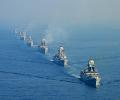
According to sources, the Indian Navy warships are on standby to provide assistance or help required by merchant vessels.

'Our diplomacy should have been focused on preventing war and avoiding the inevitable disruptions it would cause, posing a real risk to India's growth story,' asserts former foreign secretary Shyam Saran.

The harsh truth is that the US is no longer a reliable partner, cautions Ramesh Menon.

The Indian Consulate in Dubai has confirmed the tragic death of Indian sailor Herambh Karmarkar following an attack on the MV GFS Galaxy cargo vessel off the coast of Oman.

The Indian government has addressed Parliament regarding a case of an Indian national seeking repatriation from Russia due to the situation in West Asia and the Gulf region. The government also responded to queries about Indian nationals denied entry to South Korea and seafarers detained in foreign countries.

Citizens and residents across the Gulf region are preparing for Eid amidst regional conflict, impacting festivities and daily life.

Info Edge (India) shares fell 2.9 per cent after the company reported muted growth in recruitment billings for Q4 FY26, leading brokerages to expect impacted operating performance and potential margin contraction.

'It is not because of the war in West Asia, which began on February 28.' 'Petroleum product prices are already going through the roof. They are bound to have a serious inflationary impact.' 'A country's leadership is tested in trying times. It is here that the current leadership is failing.'
Travel situation from the Gulf region is gradually improving, with a significant number of passengers already returning to India.

Crude oil futures surged over 3 per cent, snapping a three-session losing streak, as renewed military escalation in West Asia revived fears of supply disruptions, driving prices higher on both domestic and international exchanges.

Iran's Persian Gulf Strait Authority (PGSA) has declared the Strait of Hormuz closed due to 'recent illegal movements' by the US military, demanding transit permits, while the US Central Command (CENTCOM) insists the strait is 'open to all vessels' and vows to ensure 'freedom of navigation'.

Teenage Indian para cyclist Lisha Das finished sixth and last in the women's C4-C5 4,000m individual pursuit qualifying event at the Commonwealth Games.

US President Donald Trump has announced the cancellation of a planned attack on Iran, contingent on Tehran agreeing to rapidly open the Strait of Hormuz and end its nuclear programme. This decision follows appeals from Middle Eastern countries and includes Israel's commitment, though Iran had previously warned against any "adventurous action" from the US.

India's handling of the Iran crisis reflects a growing strain between strategic autonomy and geopolitical alignment, observes Ambassador M K Bhadrakumar.
India significantly increased its crude oil imports from Russia and the United Arab Emirates in June, securing supplies as the Strait of Hormuz began to reopen, with Russian barrels remaining attractive due to discounts and UAE supplies offsetting earlier uncertainties.

Iran's Islamic Revolutionary Guard Corps (IRGC) asserted full control over the Strait of Hormuz, claiming two oil tankers turned back after a fire, and warned countries supporting the US against interference in the strategic waterway.

Portuguese football legend Cristiano Ronaldo is reportedly set to retire from international football in September, with speculation suggesting his final match will be Portugal's UEFA Nations League fixture against Wales.

28 Indian vessels carrying 778 seafarers are stranded in the Persian Gulf, prompting government monitoring and coordination to ensure their safety and security.

External Affairs Minister S Jaishankar has affirmed India's commitment to ensuring issues like a free, open, and rule-based maritime order, seafarer safety, and countering terror financing receive due attention at the UN Security Council during its 2028-29 term.

The United States, which entered this war in expectation of a short, sharp win along the Venezuela model, is now preparing for deeper involvement in a conflict it does not fully control, without the allies it typically relies on, against an adversary that is not behaving as expected, in a global environment that is already absorbing economic shock. Prem Panicker continues his must read daily blog on the Gulf War.

The Directorate General of Shipping has advised Indian maritime agencies to restrict the deployment of seafarers to conflict areas following a US military strike that killed three Indian crew members off the Oman coast. India has also protested the attack, which occurred amidst heightened tensions in the Gulf region.

The UN Security Council, with India's support, has adopted a resolution condemning Iran's attacks on Gulf Cooperation Council countries and Jordan, demanding an immediate cessation of hostilities and denouncing threats to the Strait of Hormuz.

The ECB cancelled the England Lions vs Pakistan Shaheens match in Abu Dhabi and postponed the England Women's training camp after US and Israeli strikes on Iran triggered missile fire across the Gulf and airspace closures.

US President Donald Trump announced the 'reinstatement' of an 'Iranian Blockade' in the Strait of Hormuz, stating the US would charge a 20 per cent levy on transiting cargo for providing security, while Iran warned against any US interference, reaffirming its authority over the critical waterway.
